Clickstream Data vs. Prompt Data for Purchase Path Analysis
Prompt data captures intent while it's forming, not after the fact.

Clickstream data and prompt data solve different problems because they capture intent at different moments: one reconstructs a decision after the fact, the other records it while it's still forming. That distinction is structural, not a matter of degree, and it's the reason conversational AI advertising counts as a genuine shift in how purchase intent gets read rather than a rebrand of search targeting with a chat interface bolted on.
Clickstream data is, at its core, a sequential record: every page load, click, and navigation step a user generates in a session or across sessions. Its analytical value has been clear for two decades, since it identifies where users drop off, lets teams optimize funnels, and reconstructs the path to purchase once that path has already been walked. Research published in Marketing Science found the predictive power is real: after six page views, purchasers can be identified with more than 40% accuracy, against a 7% baseline with no path data at all. That jump is what built the modern e-commerce analytics stack, from Google Analytics to Amplitude to Mixpanel to CrazyEgg.
The same research surfaces a catch most practitioners miss, and it's worth stating plainly: most clickstream implementations are quietly throwing away the exact data that makes prediction work. The predictive lift depends on click-by-click granularity, yet aggregate, session-level data flattens the sequence, and a large share of the industry runs on that flattened version without realizing what's been lost. Given that 98% of e-commerce visitors don't purchase on their first visit, the multi-session, multi-touch path is exactly what clickstream is supposed to make legible. Losing the sequence undermines the tool's own premise, and it happens quietly, buried in a pipeline decision nobody revisits once it's shipped.
Calling clickstream a reconstruction technology describes how it works: backward, from observed behavior to inferred intent, and that direction of travel is where its limits begin.
The structural flaw built into behavioral reconstruction
The problem sits one layer beneath execution. Clickstream reads signals already a step removed from intent itself. A click on a product page confirms someone arrived there; it says nothing about why, what alternatives they were weighing, or what question sent them looking in the first place. Intent gets inferred from the path, never observed directly, and no amount of tooling changes that.
Attribution modeling compounds the problem instead of fixing it. Last-click, linear, and data-driven models all start from the same raw clickstream and produce different answers, because each one encodes a different assumption about which touchpoints mattered. That disagreement is itself the evidence: none of these models reads intent directly, and they're guessing, with math dressed up as rigor.
Timing compounds it further. By the time a user generates clickstream data on a retailer's site, a meaningful share of the decision has usually already happened somewhere the retailer can't see. Consideration, comparison, the actual question the buyer was trying to answer: that upstream cognitive work is invisible to a system that only starts logging once someone lands on a URL.
Signal ambiguity follows from the same root cause. A visit to a product page could mean near-purchase intent, early-stage research, a competitor price check, or an accidental click from a mistyped search. Clickstream alone can't tell these apart; sorting them takes external context, which is just more inference stacked on inference. The aggregation problem from the Marketing Science research applies here too, and it bears repeating: lose the sequence, lose exactly the data that made prediction possible. Clickstream, as a data type, cannot structurally observe the thing brands actually want to know, and that's a ceiling built into the data type itself.
Where in the decision journey prompts actually appear
Analysis from Verve, drawn from more than a billion daily signals, puts the shift in plain numbers: more than 20% of users now begin their pre-purchase digital journey in AI chat rather than search. In travel specifically, that figure climbs to 37% of queries starting inside an LLM conversation. That's demand originating somewhere clickstream tools were never built to see.
Timing matters as much as share here. This activity happens upstream of search, upstream of the brand's website, upstream of any clickstream event the brand will ever log for that user. Verve's data shows a fairly consistent pattern: users go about six prompts deep into a conversation before moving to the open internet to convert. Depending on the category, that conversion can follow within 48 hours or stretch to two weeks. The window opens, then closes, whether or not a brand showed up in it.
Scale reinforces the point. As of July 2025, ChatGPT alone was processing 2.5 billion queries a day, a volume that rivals or exceeds traditional search in raw terms. Brands relying on clickstream to understand the purchase path are, for a great many buyers, analyzing a journey that only starts after the decision has already been substantially shaped somewhere else entirely.
What a prompt actually reveals that a click cannot
A click is an action, while a prompt is an articulation. That distinction separates watching someone do something from hearing them explain what they want, and it's worth sitting with because most of the industry still treats the two as interchangeable proxies for the same underlying thing.
Take the canonical comparison: a search query for "Nike sneakers" tells an advertiser someone is in-market, and not much else. A ten-prompt conversation about marathon training reveals preferences, budget constraints, timing, brand affinities, and the reasoning strung between all of them. Same product category, structurally different intelligence, because natural language carries qualifiers and constraints that a keyword strips away by design.
Here's the mechanism worth naming precisely: a prompt like "I need running shoes for a half-marathon in eight weeks, budget around a set amount" states funnel position, urgency, and price sensitivity in a single sentence. No model has to reconstruct any of it from behavioral proxies; it's just there, in the buyer's own words.
Category-level data backs this up. In sportswear, per eMarketer, 39% of prompts were upper-funnel informational, with a meaningful share also reflecting transactional intent. The interesting part is what happens to that 39%: a keyword-based system reads "informational" as "non-commercial" and discards it, when in fact those prompts often carry more purchase signal than the transactional ones, just dressed up as research instead of declared intent to buy.
One more wrinkle worth flagging: AI conversations frequently happen before a user has even settled on the search terms they'll eventually type into a search bar. The conversation sits upstream of the keyword and captures the thinking that produces the eventual query, not just the query itself. Intent gets expressed rather than reconstructed, and that's the structural difference the rest of this argument rests on.
The commercial signal concentration problem prompt data hasn't solved
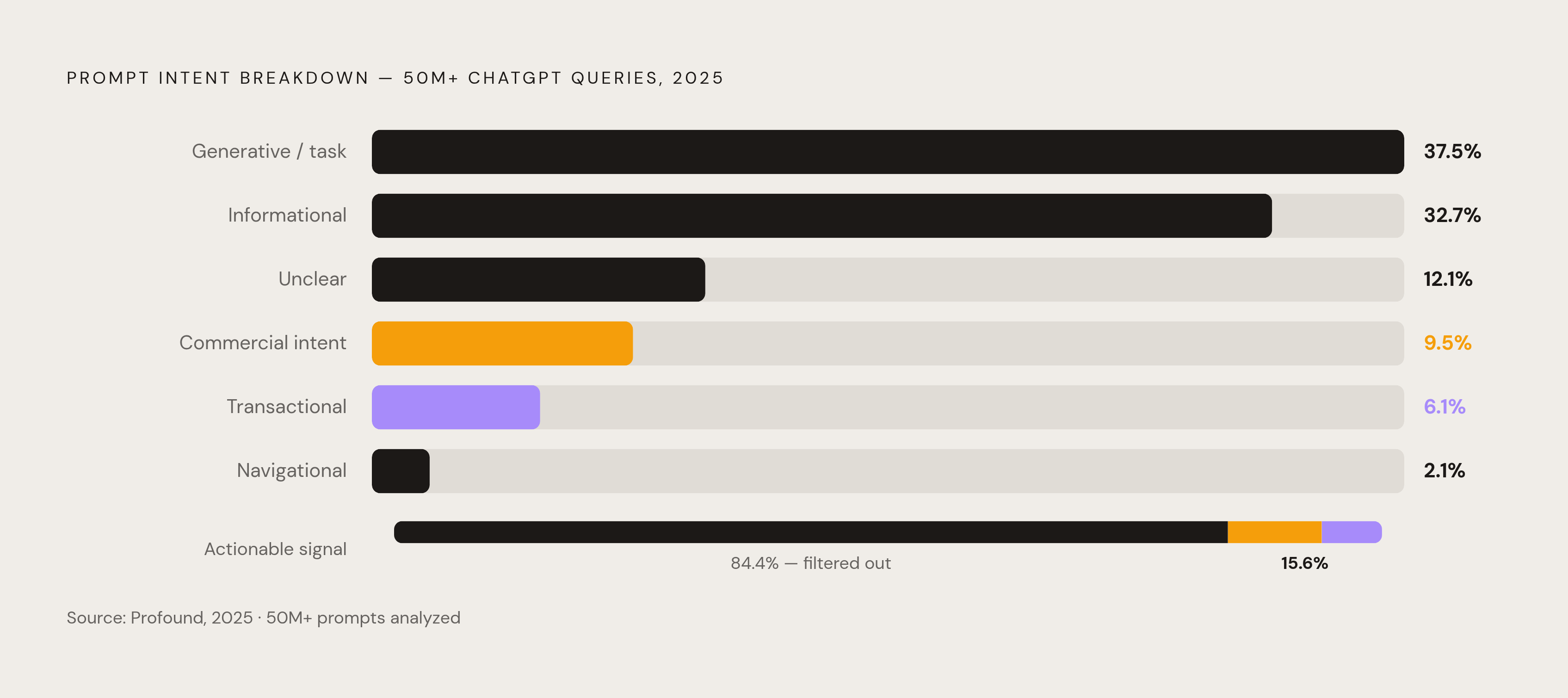
Prompt data doesn't arrive ready to use, and anyone selling it as a plug-and-play upgrade over clickstream is skipping the hard part. An analysis of more than 50 million ChatGPT prompts by Profound in 2025 found only 9.5% classified as commercial intent, with another 6.1% transactional. The rest broke down as 32.7% informational, 37.5% generative or task-completion, 2.1% navigational, and 12.1% unclear.
The tension is real: prompt data carries more information per signal than a click does, but the commercial portion of it sits diluted across a much larger volume of conversation that has nothing to do with buying anything. Clickstream has the opposite advantage, since a user in a checkout flow is almost certainly in-market, and the inference cost of reading that signal is close to zero.
Reading prompt data for purchase intent means classifying it up front, sorting the 9.5% and 6.1% from everything else before any targeting decision gets made. That sorting is what makes prompt-aware advertising a genuinely hard engineering problem, distinct from a rebrand of existing audience targeting. It's also where contextual matching (reading a conversation as it unfolds rather than tagging a static audience segment) becomes the capability that actually decides who wins here.
The sportswear category's 39% informational share is the most interesting piece of this. It doesn't look transactional on its face, but it carries detectable purchase signal underneath, and the opportunity sits in reading that signal correctly instead of writing it off as noise because it fails to match a keyword pattern. Prompt data's advantage over clickstream still has to be earned through classification, the same way clickstream's advantage had to be earned through funnel modeling, and neither one arrives pre-solved.
Why the two signals describe different parts of the same journey (and why both leave gaps)
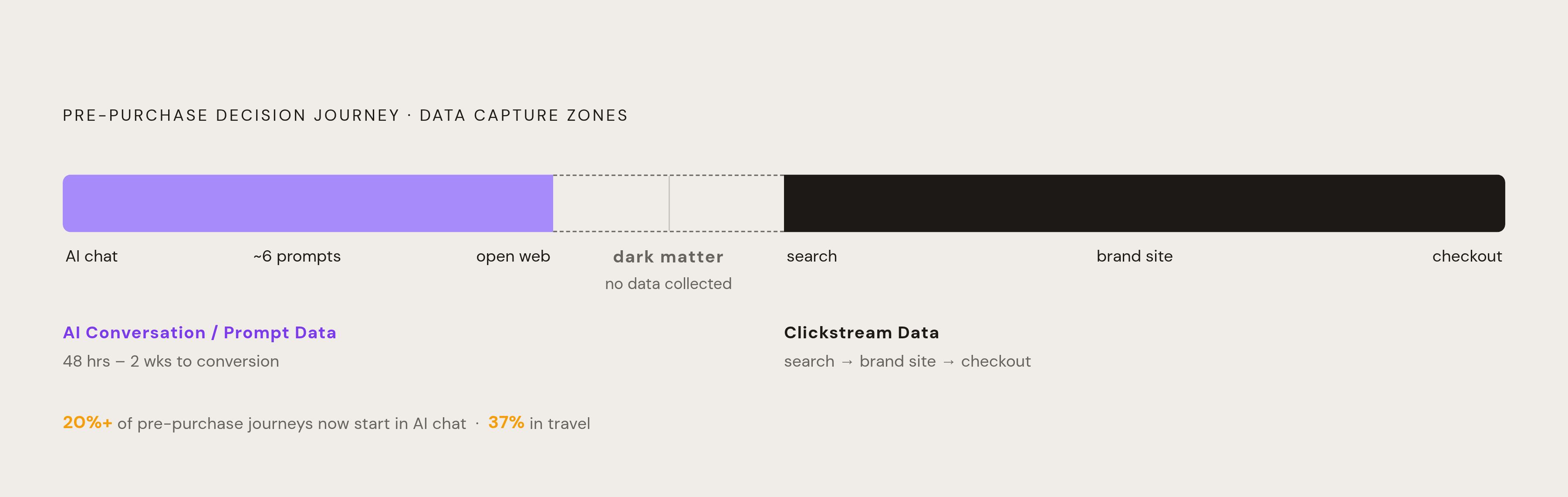
Laid out on a timeline, the two data types cover different stretches of the same road. Prompt data captures the upstream consideration phase, before search, before the brand's own site enters the picture. Clickstream captures the downstream navigation and conversion phase, once the user has arrived somewhere trackable. Stitched together, in principle, they'd describe the full arc from first articulation of a need to final purchase.
In practice, they almost never connect. Different companies control the data, different infrastructure collects it, and there's no shared identifier linking a prompt typed into an AI assistant to a click that happens twenty minutes later on a retailer's site. That's the current state of the ecosystem, and nobody's roadmap fixes it this year.
Each tool suits a different job, and pretending otherwise wastes both. Clickstream remains the right instrument for conversion optimization, funnel analysis, on-site attribution, and A/B testing. Prompt data suits demand sensing, early-funnel interception, contextual ad matching, and category-level need-state intelligence, functions clickstream was never built to serve. Verve's own framing gets this right: AI conversational data extends search intent, running alongside it rather than replacing it, handling different kinds of queries for the same users.
What neither covers is the middle: the stretch between when a user closes an AI conversation and when they show up on a brand's owned surface. Call it the dark matter of the modern purchase path, present in the data everyone agrees exists, invisible in the data anyone actually collects. That reframes the operative question for purchase path analysis, which is no longer just how a user navigated a given site, but where that user's consideration actually started, and what shaped it before the brand ever saw them. Clickstream stays useful even as it grows less sufficient, on its own, to describe a growing share of buyers' journeys.
What acting on prompt data requires that clickstream-era infrastructure wasn't built for
Clickstream infrastructure was built for looking backward. Data gets collected, cleaned, modeled, and used to optimize the next campaign, on a loop measured in days or weeks. That cadence made sense for a world where the relevant signal was a historical behavioral profile.
Prompt data doesn't tolerate that lag. The relevant signal is the conversation happening right now, and it decays fast; a user mid-conversation about marathon shoes is in-market at that moment, not in a way that's still useful to know about next Tuesday. Reading that signal well means reading it in real time, an infrastructure requirement clickstream tooling was never designed around. Programmatic infrastructure built for AI chat, such as Thrad's DSP and exchange, is designed around that real-time constraint from the start.
Keyword targeting, the backbone of search advertising for two decades, doesn't map onto this kind of intent either. A prompt isn't a keyword, and bidding on "running shoes" doesn't surface an ad inside a conversation where someone writes, "I want to run my first half-marathon and I'm not sure where to start." That sentence requires semantic interpretation, not string matching, and the entire auction architecture built for search assumes string matching. This is the part the industry keeps underestimating: the shift runs deeper than a targeting tweak, and treating it as one is going to waste a budget cycle for whoever tries.
The ad format has to shift accordingly. A native, contextual placement inside a conversational response is a structurally different object than a sponsored link tacked onto a search results page. Perplexity's Sponsored Follow-Up Questions model, before the company's acquisition, offered one version of this: ads that appeared as suggested continuations of the conversation rather than interruptions to it. Academic work on LLM auction design, including the LLM-Auction framework proposed by Zhao and colleagues in 2025, points the same direction, toward models that integrate relevance and bid at the generation layer itself rather than bolting an ad slot onto finished output.
Major AI platforms haven't converged on one answer, and treating that as an oversight misses the point; nobody has cleanly solved for both halves of the problem yet. Some treat conversational data as a signal for targeting users off-platform, the approach Meta has taken, while others experiment with placing ads inside the conversation itself. What a genuinely prompt-native system needs is reach across AI surfaces, not just one, combined with the ability to read conversational context in real time. A generalist demand-side platform typically has the first without the second, and a single-surface AI ad network usually has the second without the first. The gap between those two capabilities is currently the whole ballgame.
What this means for how brands should think about intent going forward
The purchase path has grown a new upstream segment, and most brand measurement programs currently treat that segment as if it doesn't exist. Waiting for a user to generate clickstream data means meeting them only after their consideration has already taken shape, often shaped by whichever competitor did or didn't show up in the AI conversation they had first. Brands that keep treating clickstream as the whole map are, without realizing it, measuring only the back half of a race.
That has a category-level consequence. Brands present during the six-prompt consideration window are participating in an earlier, more formative stage of the decision than brands that only show up in search results and on-site. One group shapes the decision; the other inherits whatever's left of it, and no amount of on-site optimization closes that gap after the fact.
For measurement teams, purchase path analysis anchored to the first tracked click no longer describes a complete journey. Prompt-level data needs a seat in the analytical framework, not as an afterthought bolted onto existing dashboards, but as a distinct input describing a distinct phase. For media teams, the operative question changes shape too, no longer just how to capture in-market intent, but how to show up while intent is still being formed, and that demands different channel and format answers than the ones search advertising trained brands to reach for.
None of this comes with a tidy measurement story attached. Attribution in conversational AI environments remains genuinely unsolved; the field has nothing like the standardized pixel-and-click infrastructure that made clickstream analysis tractable in the first place. The IAB Tech Lab's AI Content Monetization Protocols working group, formed in August 2025 with roughly 80 executives from publishers, cloud providers, and AI monetization platforms, is an early attempt to build toward standards, and those standards aren't settled, and won't be for a while.
What should be settled is the framing. Prompt data and clickstream data observe different moments in a decision, they require different infrastructure to act on, and together they describe a purchase path that neither one covers alone. Brands treating this as an incremental channel question, another line item in the media plan, will move slower than the ones that recognize a structural change in where consumer intent becomes visible at all.