Linguistic Markers of Purchase Readiness in User Prompts
Only one in six AI prompts signals buying intent, making precision targeting essential.

A prompt is a complete statement of intent: budget, timing, prior experience, constraints, all volunteered in one turn, with none of the guesswork that keyword matching or demographic targeting requires. That difference is the entire premise of advertising inside AI conversation, and most of the industry building on top of it is treating every prompt as a lead, when the actual work is knowing which ones aren't.
Consider the gap directly. A search query like "best running shoes" is a fragment stripped of everything useful: no budget, no timing, no sense of what the person has already ruled out. Demographic targeting fills that gap with probability, inferring intent from who someone is rather than what they said. A prompt closes the gap differently, which is the problem platforms like Thrad, a DSP built to buy against conversational AI inventory, were designed around. A user telling an AI assistant they need a family SUV under a certain monthly payment, that they currently drive a diesel, and that they want to decide before their lease ends in March, has handed over budget, incumbent product, and deadline in a single breath. Same category as "best eco-friendly SUV," entirely different universe of signal. Per Verve's analysis of more than a billion daily signals, over 20% of pre-purchase digital journeys now begin inside an AI chat. That is a fifth of the funnel today, and reading these prompts correctly is the precondition for any of it to work.
The distribution problem: most prompts are not buying signals
An analysis of many millions of ChatGPT prompts in 2025 found that only about one in six carried commercial or transactional intent. The rest were research, curiosity, troubleshooting, or plain task completion. That ratio is the number that matters, not the raw volume of AI queries, which is enormous and growing regardless. A large denominator makes a channel look bigger than the addressable opportunity actually is. Commercially relevant inventory is a subset of that volume, and finding the subset is the actual job.
Get this wrong and the cost is not just wasted spend. An assistant that surfaces a product recommendation in response to "what is X" or "how does X work" teaches its users to distrust the interface itself. Once that happens, well-targeted offers get tuned out along with the bad ones, and there's no getting that trust back cheaply.
So the discipline runs in two directions. Intent detection means catching the signal when it shows up. Intent suppression means saying nothing when it doesn't, reliably enough that users never learn to brace for an ad every time they ask a plain question. Definitional questions, troubleshooting threads, venting: these should return nothing, on principle, not as an edge case to handle later. Precision governs whether this channel works. Reach doesn't.
The four linguistic clusters that mark a buyer
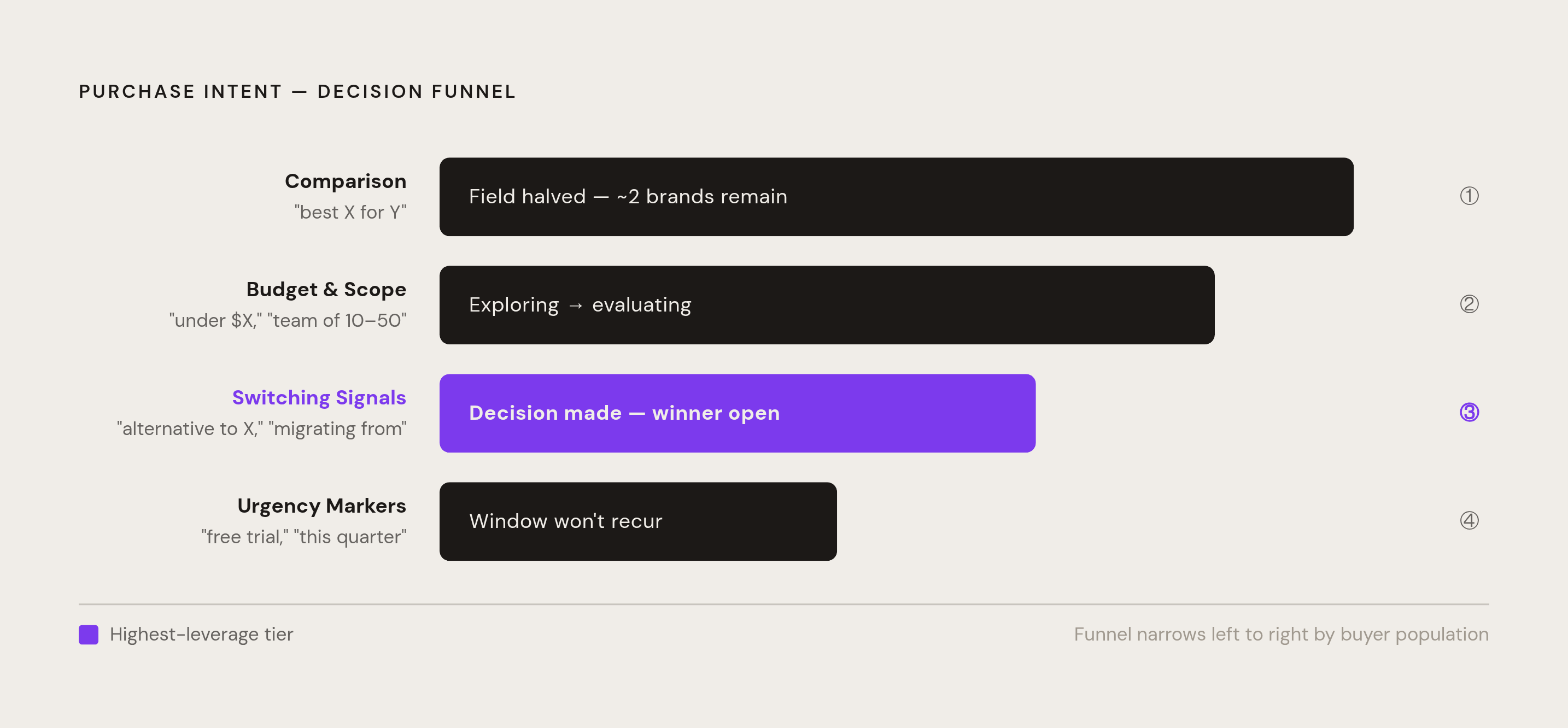
None of this requires a linguistics degree to apply. Four clusters cover most of the useful ground, and each maps to a distinct point in the decision journey. The trick is that they look similar on the surface and only separate once you look at what's actually being volunteered.
Comparison phrases ("best X for Y," "X vs. Y," "which is better for my use case") signal a buyer who is already category-aware and has narrowed to a shortlist. This is late-middle funnel at the earliest. Verve's data puts a number on how narrow: a user who begins their pre-purchase journey in AI chat ends up considering roughly 2 brands, against roughly 4 for someone who starts in search. A comparison-phrase prompt is happening inside a field that has already been cut in half.
Budget and scope qualifiers ("under $X," "pricing," "for a team of 10 to 50," "fits our budget") mark the shift from exploring to evaluating. In B2B contexts, a single prompt carrying budget, team size, and timeline together is doing the work of three separate qualification questions a sales rep would otherwise have to ask one at a time.
Switching and alternative signals ("alternative to X," "migrating from," "we've been using X but," "ready to switch") are the highest-value cluster in most categories, full stop, because the decision to buy has already been made. What's left to determine is only who wins the business. An incumbent is in place and losing ground; that's a very different conversation than a cold start, and it should be priced like one.
Urgency and readiness markers ("free trial," "how do I sign up," "this quarter," "before [date]") indicate a deadline, self-imposed or otherwise. Time-bounded prompts compress the window in which an ad can influence the outcome. Miss it, and the moment doesn't come back around the way a search retargeting window does.
The inverse list matters just as much operationally. "What is X," "how does X work," "DIY," "free way to" are researcher signals. They belong on an exclusion list, and any system that hasn't drawn that line yet is guessing.
How multi-turn conversation reveals funnel position over time
A single prompt can be ambiguous. A thread rarely is. Picture a user whose first message asks what to look for in a project management tool, whose second adds that the team is about 20 people and mostly remote, and whose third states a need to have something in place by end of quarter. By the third turn, comparison framing, scope qualifiers, and urgency have all shown up in sequence, even though no individual message would have qualified as a strong signal on its own.
Keyword search cannot do this. Each query stands alone; the system has no way of knowing this is the same person on their third research session of the week. Conversational interfaces preserve that continuity by default, which is what makes them a richer intent surface than search ever was.
Category data backs this up unevenly, and that unevenness is itself informative: the four-cluster taxonomy is a starting point, not a universal law. In sportswear, upper-funnel informational prompts and transactional prompts run at roughly equal share, meaning the distinction between them only becomes useful once a system can track which type of prompt a given user is currently in. Travel is the clearest example of a multi-turn journey in practice: Verve's data shows 37% of travel queries begin inside an LLM, and the progression from destination research to logistics to booking readiness tends to unfold across a visible thread rather than a single query.
The operational lesson is that the first commercial signal in a conversation is usually not the right moment to act. Academic work on detecting buying-intention signals in dialogue, including BERT-style classification approaches applied to sales conversations, has found that explicit intent markers cluster toward the end of exchanges rather than the beginning. Patience in placement is a feature of how people actually think out loud.
What the narrowing consideration set means for ad placement strategy
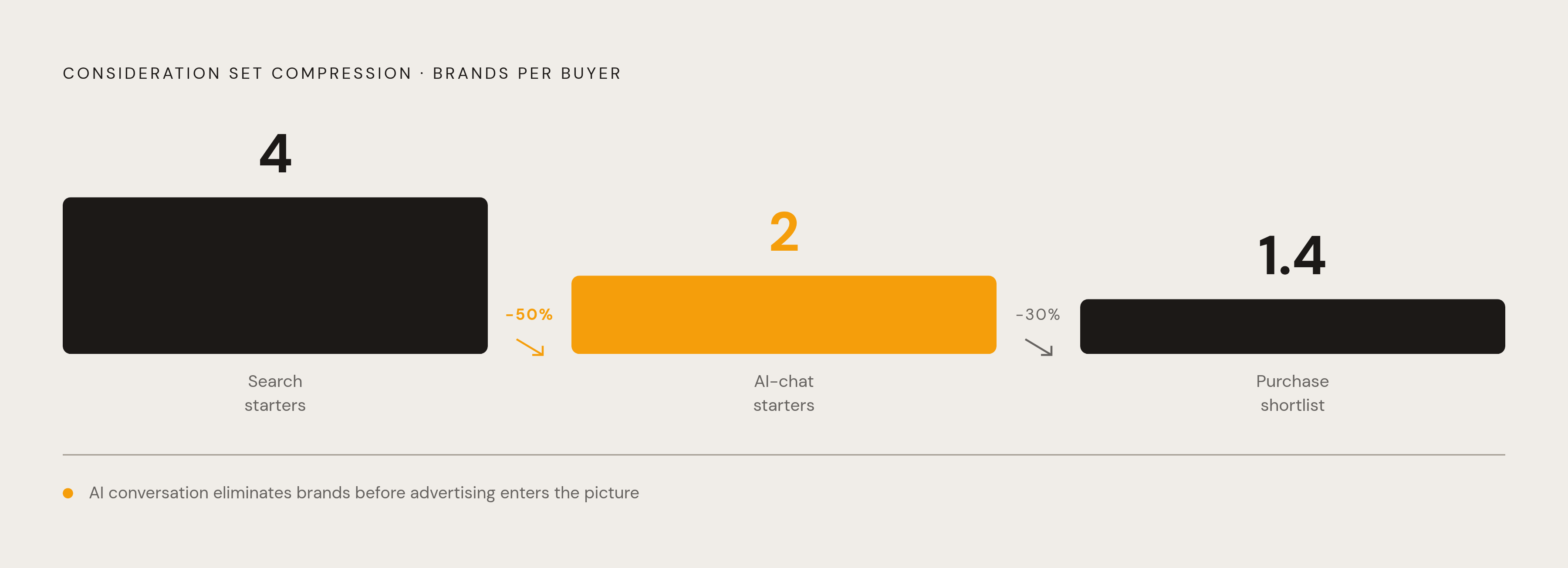
The Verve numbers deserve to stand on their own rather than get folded into a footnote. Roughly 2 brands considered for AI-chat starters, roughly 4 for search starters, and a final shortlist entering the purchase decision that averages around 1.4 brands. Put plainly: the AI conversation is doing most of the evaluation work before the user ever encounters an ad.
That has a consequence most impression or click reports won't show. A brand absent from the comparison and switching conversations isn't just losing clicks at the bottom of the funnel; it may be structurally excluded from consideration before a bottom-of-funnel prompt ever appears. By the time someone types something ad-ready, the field has often already been decided, and no amount of retargeting fixes that after the fact.
This changes what a matched impression is worth, and most buyers are still pricing it as if it doesn't. The linguistic clusters described above measure how narrow the field already is at the moment of the match, and therefore how much is riding on it. A smaller volume of late-funnel conversational matches, where the consideration set has already tightened to two or three names, is worth more than a much larger volume of early-funnel impressions where the field is still wide open. Volume was the currency of the keyword era. Narrowness is the currency here, and treating them as interchangeable is the fastest way to overpay for the wrong inventory.
How targeting and ad delivery work inside a conversational interface
The mechanics differ from search in a structural way. A Google Search ad matches a keyword typed into a query box and appears in a labeled section set apart from organic results. A conversational ad matches the intent of an entire exchange and appears inside the generated response itself, woven into the answer rather than beside it.
The formats reflect that: sponsored questions, contextual suggestions, native product cards that surface as part of an answer rather than around it. When a user asks a shopping assistant to compare vacuum cleaners and a sponsored card appears alongside the comparison, it reads as part of the recommendation, not as an interruption to it. That's a different psychological contract with the user than a banner ad ever had.
ChatGPT's documented ad system uses hint-based targeting, where advertisers build separate creative and landing-page pairs for each rung of intent. A purchase-ready signal should route to a pricing or trial page. A product-aware signal should route to a comparison page instead. Mismatching these is one of the most common and costly failure modes in the channel: a bottom-of-funnel user who gets dropped onto a generic homepage bounces, and the advertiser has just paid for the single most valuable signal the system produces and thrown it away on the wrong destination.
Auction mechanics are still being worked out industry-wide, and this layer is genuinely unsettled. Research frameworks examining retrieval-augmented generation, including work on how bids and retrieval relevance get jointly weighted in ad allocation, are pushing toward systems that optimize response quality and revenue at the same time, though production implementations vary by platform and remain early. For an advertiser building campaigns today, the practical move is to let the four-cluster taxonomy set the targeting structure directly: each cluster becomes its own bid tier, with its own creative, its own call to action, and its own landing page.
The trust constraint that determines how much signal you can act on
None of this works if users stop trusting the answers. Ipsos found that 63% of US adults trust AI answers less once those answers contain ads. That is the central tension the entire channel operates under, and it should discipline every decision described above.
Perplexity's decision to limit certain ad formats, citing accuracy and trust concerns, is the clearest case study available. This is a platform with documented CPM rates of $20 to $42 for native conversational placements, meaningful revenue on the table, and it still concluded that the trust cost of certain formats outweighed the money.
ChatGPT moved the opposite direction and reached $100 million in annualized ad revenue within weeks of launching native ads. Sitting these two data points side by side is more useful than picking a winner: advertising inside AI clearly can work, but format and targeting discipline are what separate the two outcomes, not the ad format itself. What preserves trust is an ad that matches the conversational context closely enough to feel like information, that appears only once a signal clears a real threshold, and that stays silent otherwise. What destroys it is irrelevant placement, repetition past the point of usefulness, ads triggered by clearly non-commercial questions, or any format that makes a user feel tracked rather than helped. The linguistic precision this piece has been describing is the only thing keeping the ad product viable at all.
What prompt-level intent data cannot yet tell you — and why that matters for measurement
Attribution across this channel is genuinely unresolved, and pretending otherwise is the least defensible position anyone in this space can take. A user describes a problem to an assistant, sees a native recommendation, and converts three days later through a direct search or a visit to the brand's own site. The conversational touchpoint that arguably started the whole journey may never appear anywhere in the attribution path.
The consideration-set compression numbers from earlier (roughly 2 brands for AI-chat starters against roughly 4 for search starters) prove that these conversations exert real influence on what people end up buying. But most measurement infrastructure was never built to see where in the journey that influence actually happened. It's a known effect with an unmeasured mechanism, an uncomfortable place for an industry used to clean attribution paths to sit.
Prompt signals also describe a moment, not a guarantee. A user who volunteers every purchase-ready marker in a single turn (budget, timeline, switching language) may still not convert for weeks, or ever. Multi-turn signal accumulation helps close that gap conceptually, but most ad systems in production today are matching against individual turns, not reading a thread as a sequence the way a human observer would.
The honest position, after weighing what the data does and doesn't show, is that prompt-level linguistics represent the most precise intent signal the advertising industry has produced to date, and that precision is still incomplete. The right response is to act on the signal with discipline, measure whatever the current infrastructure allows, and keep pushing on attribution rather than pretending the gaps aren't there. Brands and agencies entering this channel now should treat their first campaigns as structured experiments: the specific patterns that predict conversion in any given category will diverge from the general taxonomy laid out here, and they only become reliable once tested against a brand's own data, not before.