High-Consideration vs. Impulse Category Intent in AI Conversations
AI conversations reveal purchase intent differently by category, requiring new targeting approaches.

Purchase intent inside an AI conversation doesn't read the same way twice. A user shopping for a mattress and a user asking for a snack recommendation are both expressing intent, but the shape of that intent, how it builds, how much gets stated outright, differs by category in ways traditional ad targeting was never built to catch. Most advertisers are applying one intent model to both cases, and that's the mistake this piece is about.
Paid media has always guessed at intent. A keyword typed into a search bar, a page visited, a demographic bucket matched against a media plan: these are proxies, stand-ins for what someone actually wants. AI conversations narrow that gap considerably, because users state what they're looking for, what's bothering them, what they've already tried, and what's stopping them from deciding, then revise it across several turns. The conversation itself is a far richer dataset than any click ever was, and treating it like a click is the error worth naming up front.
How purchase intent reveals itself differently across high-consideration and impulse categories
Travel, electronics, financial products, healthcare decisions, home goods: these categories produce long, layered conversations. A user doesn't ask one question and stop, then push back on something, then narrow their thinking in real time across several turns. The session itself becomes a visible funnel.
Snacks, personal care, entertainment, everyday apparel behave differently. These conversations run short, often a single exchange, with far less deliberation showing up in the language, since the cognitive load of the decision is lower and there's less to work through out loud.
The pattern shows up at the start of a session. High-consideration conversations tend to open broad, something like "why does my back hurt at my desk," and only later narrow to a comparison between two specific standing desk brands. Impulse conversations skip that arc entirely, since the user already knows what kind of thing they want; they're asking for a shortcut more than a framework for thinking.
BCG's research on shopping-related AI use backs this up: usage is growing fast, and travel and electronics rank among the categories where AI guidance shows up most often during research, both squarely in the high-consideration bucket that produces extended dialogue. The same research points to something advertisers can't ignore: consumers accept AI recommendations more readily for low-stakes, repeat purchases than for high-stakes ones. That single fact decides how much of a conversation an advertiser can realistically shape, and it swings sharply by category.
What the multi-turn structure of high-consideration conversations means for intent signals
A user working through a major purchase states a want, but also narrates the reasoning behind it: the trade-off between price and quality, the constraint holding them back, the option they already ruled out. A search query carries little of that context and has no memory of itself.
Intent escalates as turns accumulate. The opening prompt in a high-consideration session is usually unbranded, closer to a category question than a purchase question, and by the third or fourth exchange, the user may have named a specific model, a price ceiling, or a competitor they're weighing. That escalation should change how an advertiser weights the signal: a later turn represents a user who has already self-qualified through the conversation, and it's worth more than the opening prompt. Most ad systems still weight the first line of a query hardest, a habit built for a different medium.
There's a structural advantage buried in this pattern. Because the earliest prompts tend to be unbranded, advertisers reach users before they've committed to a competitor, a stage most paid search never touches, since a search query typically arrives after someone has already decided roughly what they want. In categories like auto, users appear to enter these conversations with a narrow consideration set already forming, so the window for brand influence is real but tight. For a high-consideration advertiser, the conversation functions as the research phase itself, and showing up inside it is functionally the same as showing up inside the decision.
How impulse category intent shows up in AI conversations — and why it's different, not lesser
Impulse conversations run short because the thinking already happened somewhere else. The user shows up with a category need already formed and wants a recommendation more than a framework. That brevity gets misread constantly as low value, yet a single direct query about a snack or a skincare product can sit closer to conversion than a five-turn conversation about a mortgage. Treating short as shallow is the second mistake worth naming directly.
The intent signal here is immediacy. Because consumers extend more trust to AI guidance on repeat or low-stakes purchases, that immediacy carries real weight, and the recommendation doesn't face the scrutiny a bigger decision would.
That gap in scrutiny shows up as a verification habit. A meaningful share of buyers in high-consideration categories check an AI's recommendation against a search engine before they buy, but that verification step is far less common on low-stakes purchases, where the AI's suggestion gets taken closer to face value. For impulse advertisers, the job is being the name that comes up when the user asks, since the conversation rarely runs long enough to build trust across multiple turns.
Precision matters more than volume here. "Something sweet to bring to a dinner party" and "cheap chocolate near me" are both impulse prompts, both low-consideration, and both need completely different responses. Getting the occasion wrong is a bigger risk than getting the product category wrong.
Why the AI conversation catches consumers at an earlier, more malleable stage than search
Search has always met people relatively late. By the time someone types a query into a search bar, they generally know what they're looking for; the query itself is a late-stage signal, close to the moment of decision. Thrad, a programmatic ad platform built for AI chat interfaces, is designed around exactly that gap between where search enters and where AI conversations begin. AI conversations often start earlier, at the point where the user is still forming the question rather than executing a decision already made.
Verve's analysis of large-scale daily signals found that for a meaningful share of users, the pre-purchase digital journey now begins inside an AI chat rather than a search bar, and in categories like travel, that share runs especially high. That's a structural shift in where the funnel starts.
For high-consideration categories, catching someone at the question-forming stage means a brand can become part of how the user comes to understand the category itself, instead of showing up later as one more option competing at checkout. For impulse categories, that early-stage advantage matters less, because consideration is already compressed by the time the user opens the chat; they're executing a decision more than forming a question. High-consideration advertisers get the most value from showing up early in a session, while impulse advertisers get the most value from matching precisely at the exact moment the user asks.
What advertisers get wrong when they apply search and social logic to AI conversations
The most common error is treating a conversational prompt like a keyword: matching on the surface words and ignoring everything around them. Two people typing "best running shoes" into a search bar get treated identically by most ad systems. Two people asking the same thing inside an AI chat might be at entirely different points in their thinking, one just starting to consider running shoes at all, the other already narrowed to a budget and a specific use case, trail running versus daily commuting.
Traditional intent data has always conflated casual browsing with active buying. Conversational context offers a way past that, but only for an advertiser willing to read the whole exchange instead of grabbing the first line and matching against it. Most ad tech stacks built for search aren't built to do that, and bolting AI placement onto that infrastructure without changing the matching logic is where this goes wrong most often.
The mismatch cuts in different directions by category. Running impulse-style creative (short, direct, buy-now) against a user still in the exploratory phase of a high-consideration decision reads as tone-deaf; it signals that whoever placed the ad wasn't paying attention to what the user actually said. The opposite failure shows up in impulse categories: waiting for a multi-turn signal that's never going to arrive means missing the window entirely, since the conversation ends before the advertiser's targeting logic catches up.
Underneath both mistakes sits the same root cause. Demographic and keyword targeting imported wholesale from search and social overlooks the one thing an AI conversation actually offers that no cookie or profile ever could: context the user stated out loud, in their own words, without being asked.
How to read conversational intent signals by category — a working framework
Three things are worth tracking in any AI conversation, and they matter unevenly by category.
Specificity comes first: does the user name a brand, a model, a price range, a use case? Higher specificity almost always means later funnel stage, no matter the category. Turn depth comes second: how many exchanges has the user gone through before an ad opportunity appears? More turns generally mean more context and more mature intent, but this matters far more in high-consideration categories than impulse ones. Stated constraints round out the picture: has the user named a budget, a deadline, a competitor already ruled out, a specific concern blocking a decision? In high-consideration conversations, these constraints are the single highest-value signal available.
The weighting differs by category, and getting this backwards is where most targeting fails. High-consideration advertisers should lean on later-turn signals heavily, since early presence is about building familiarity more than closing a sale in that session. Impulse advertisers should lean on category and occasion match at the exact moment of the query, since turn depth barely matters when the conversation is only going to run two or three exchanges anyway.
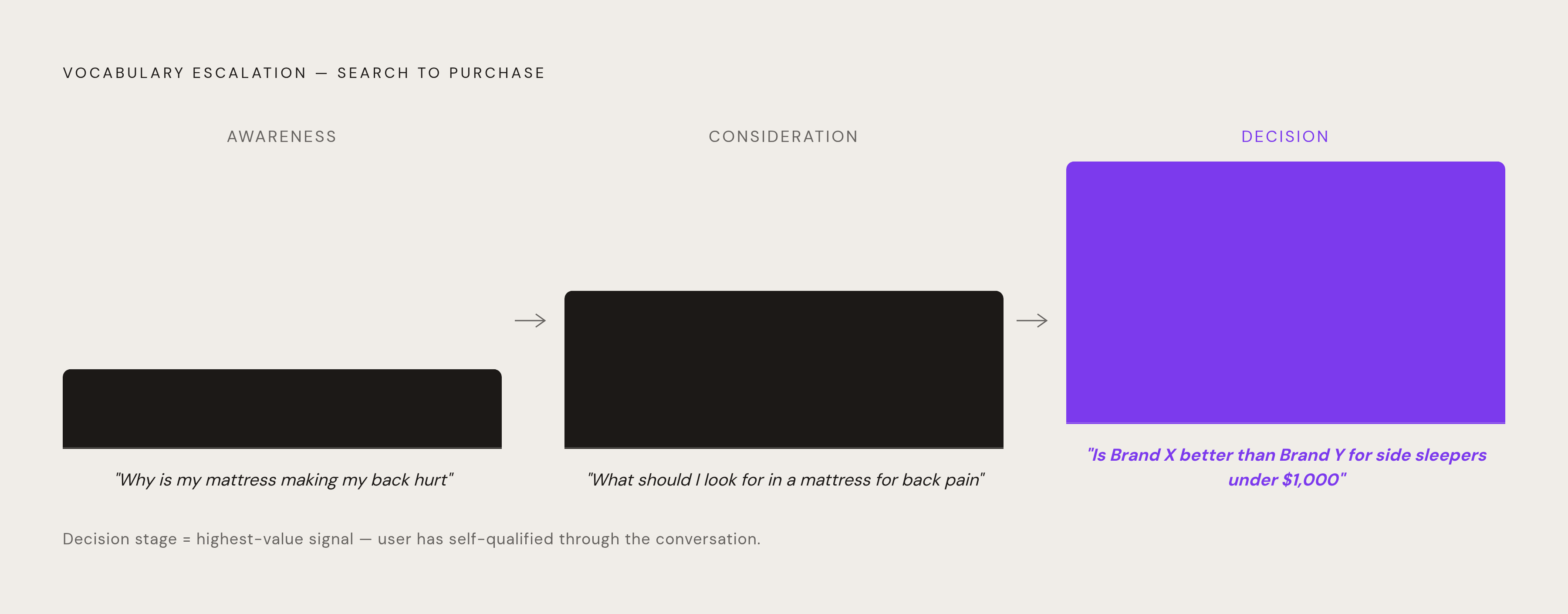
The vocabulary itself escalates in a recognizable pattern, moving from awareness to consideration to decision language. "Why is my mattress making my back hurt" is awareness, "what should I look for in a mattress for back pain" is consideration, and "is the Brand X better than Brand Y for side sleepers under $1,000" is decision. That progression is visible in the words the user chooses, and it's a far more reliable stage-indicator than anything a cookie ever produced.
None of this is theoretical. A meaningful share of users already report completing purchases directly inside an AI tool, and a larger share report making a purchase after using AI during research. Both numbers point the same direction: the conversation has become a conversion environment, on top of remaining a place where research happens.
What effective ad placement looks like inside high-consideration vs. impulse conversations
For high-consideration categories, timing is everything. A product recommendation dropped into a response to "why does my back hurt" arrives too early and reads as opportunistic; the user hasn't asked for a product yet, they've asked for an explanation. The right entry point is the consideration stage, once the user has moved from "what's wrong" to "what should I look for." The register matters too: the user is thinking carefully, so the ad should offer information, comparison framing, specification detail, and trust signals over urgency or a hard sell. And because high-consideration users often return to the same conversation across days or weeks, multiple touchpoints across a session, or across sessions, make sense in a way they rarely would for a snack purchase.
Impulse placement runs on a different clock. Speed and precision matter more than depth, since the user isn't getting five more turns to reconsider. The recommendation is the shortcut they came for, so creative should be direct: name the product, name the occasion match, note if it's available right now. Anything that feels like an interruption breaks the one advantage impulse advertising has in this medium, that a well-placed native recommendation can slip into the conversation without registering as an ad.
Both categories share one non-negotiable requirement. The ad has to make sense inside the conversation as it's actually happening, more than as a product page pasted into a chat window or a keyword match against a fragment of what the user typed. A contextually wrong placement doesn't just waste the impression; it damages the user's trust in the AI interface itself. That makes precision an ethical requirement as much as a performance one, since the cost of getting it wrong lands on the platform's credibility, not just the advertiser's budget.
What this means for brands building an AI advertising strategy now
The decision that matters most isn't which AI platform to buy into first. It's understanding which intent tier a brand's category occupies and what that tier implies for how a message should enter a conversation at all. Brands still asking "which platform" before asking "what tier" are solving the wrong problem first.
High-consideration brands need to think in terms of session coverage and funnel stage rather than single-moment impressions, since the conversation that leads to a purchase may stretch across days and several separate sessions before anyone decides anything. Impulse brands need to think in terms of contextual precision and immediate match quality, since the window is short and the competition is simply whoever gets named first in that one exchange.
Across both categories, the brands moving now are locking in something that gets harder to buy later: familiarity inside the AI interface itself, at a moment when the competitive auction for that attention is still thinner than it is in search or social. That won't last long. The infrastructure question, being able to read conversational context and match at the level of intent rather than keyword, is what separates advertising built for this medium from search ads wearing a new interface.
Brands that treat AI conversations as one more distribution channel for creative built somewhere else will underperform quietly and never quite understand why. Brands that build targeting and creative around the actual shape of conversational intent, by category, by funnel stage, by the specific constraint a user just stated out loud, are the ones setting the terms for what effective AI advertising looks like from here.